Table of Contents
Introduction
There are not many other hairstyles, as widely popular, as the fade. Yet, the question remains same about Low Fade vs High Fade: what is more appropriate to you?
Though both of these styles fall in the same group of fade hairstyle, the point where the fade begins will change drastically the whole image of what you will look like. Low fade produces a clear, sharp and professional final finish. A high fade on the other hand extinguishes high contrast and a more characters and accented look. Even positioning will be capable of influencing the perceived degree of organization of your face, the perceived freshness of your haircut and even the rate at which it is maintained.
It is not just a trend but also depends on the shape of the face, life and occupation, and style that is the reason this decision is between the low and the high fade. The decision made inappropriately may make your haircut look imbalanced. The correct decision can boost your whole appearance.
What is a Fade Hairstyle? Rapid Foundation Pre-Comparison
What is a Fade Haircut?
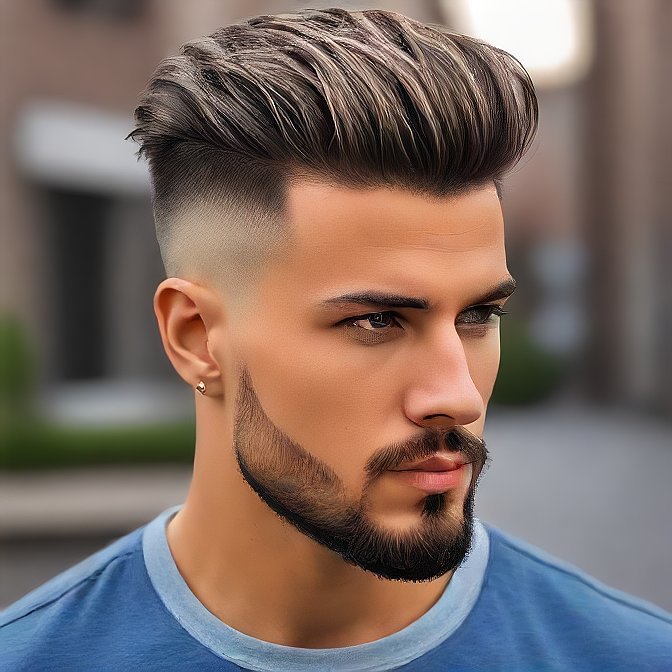
Fade haircut is a hairstyle whereby the hair length is cut shorter to an almost touching hair length on the sides and the back of the head and longer on the head top. The missing of the contrasting edges in hair strands is simply known as a fade – the fade appears even and is incorporated into the overall hair. Rather than that, the cut will be died away one length to another and this produces a sharp, smooth finish.
The same fades will match most styles on top like quiffs, pompadours, buzz cuts, a textured crop or even curly. This feature is one of the main reasons why the fade haircuts are considered to be one of the main articles of grooming nowadays.
The work of Blending and Tapering
The principle of a fade is its amalgamation. Barbers put on clippers of varying guard sizes progressively reducing the hair length as they shave their heads. It is aimed at removing the observable lines amongst segments.
The hair around the side burns and neck is narrowed in length, called tapering. Although every fade involves the use of tapering, not all tapers are fades. A taper is not as sharp and will usually be limited to the edges but a fade will give a much clearer transition higher on the sides.
The resulting appearance depends on the extent of mixing, smooth, sharp or dramatic.
Incidental Difference between Skin Fades and Shadow Fades
This difference should be realised prior to comparing fade heights.
Bald fade (also known as skin fade) has a fade extending all the way to the skin. The uppermost strip is completely bare and there is an extreme contrast between skin and hair with nakedness.
A shadow fade is not completely to the skin. Instead, it becomes extremely short hair, therefore, making a gentle shadow effect. This offers a less sharp and to a smaller extent, conservative finish.
Low, mid or high fades can be effected both on skin and shadow.
The reason behind Why Fade Placement Alters General Effectiveness
The fade point at which it begins differs greatly from the overall appearance of the haircut.
A fader is lower leaving more hair on the sides, thus creating a softer and more balanced figure. A greater fade removes a greater bulk on the sides, creating less difference, creating a fuller and more intense look on the top.
Fade placement affects:
- Face shape perception
- Visual sharpness
- Professional suitability
- Styling impact
- Maintenance frequency
This is one of the reasons why you should grasp fade height before deciding whether to have a low fade or a high fade.
Check Out: Haircuts That Make Thin Hair Look Thicker: Proven, Volume-Boosting Styles That Work.
High and Low Fade: What is the Difference between them?
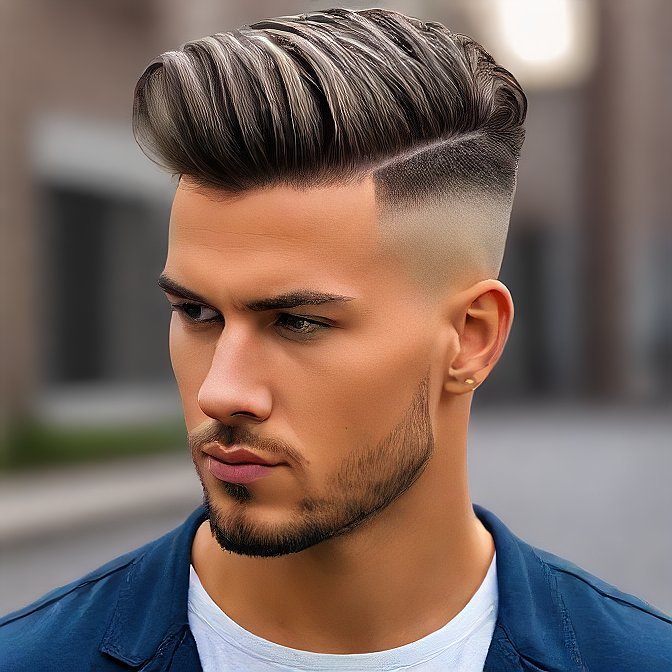
The crucial difference in the Low Fade and High Fade argumentation lies in where the fade starts and the degree of contrast change that the fade bestows. It is that little fact which makes the difference between your haircut looking subtle and classy and dramatic.
What Is a Low Fade?
The fade is minimal and begins on the ears and flows around the hairline, curvy. The transition between short and long is done at a lower position on the head, which conserves more weight and bulk on the sides.
Due to the low fade beginning:
- The technique of hair extension is gentle.
- The general appearance is austere and simple.
- The hair is a conservative cut.
- It is appropriate in the workplace.
The low fade is the best choice among men looking to have a smooth, casual style without a very high contrast line. It matches standard hairstyles and meshes with beards.
What Is a High Fade?
The fade begins rather high up the head, over the temples. This makes a lot of hair removed on the sides early into the cut, with a stark contrast between the top and sides.
Since the fade is higher initially:
- Sides are depicted in an exaggerated way.
- The structure of the face is emphasized.
The contemporary and edgy hairstyles have a high fade. It adds volume to the top and provides a bold, statement look.
Low vs High Fade Side-by-Side Comparison
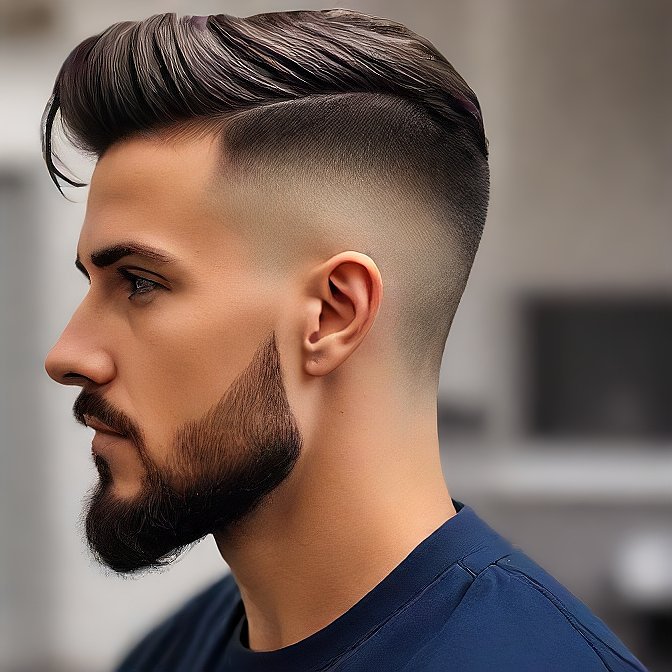
In the case of Low Fade vs High Fade, not only is the difference found in the location of the fade. The length is directly connected with the contrast, upkeep, adaptability of the haircut, and its compatibility with your trends.
A clean, scannable comparison is given below in order to enable the readers to find the option best suited to them in a short time.
Key Features
- Use low fade when you need the opportunity to be diverse, do minor refinements and grow-out easier.
- Use a high fade to achieve a high contrast, increased definition and statement appearance.
- The more any fade, the more dramatic the hairstyle.
These variations are learnt and when you get to the barber chair you are able to know which option to make.
Fade GuideFace Shape: What Fade to make your features?
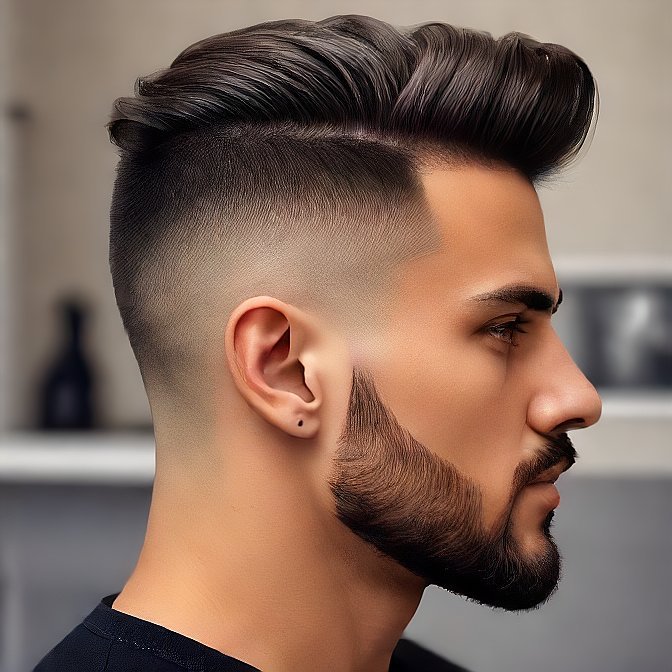
Face shape will be one of the factors that will either make or break whether the low fade or high fade that will add to your overall appearance. The intention is to create a visual equilibrium with the height addition, softer angles or in proportion.
And here’s the way to utilize that strategy now.
Round Face: A vertical addition of Length must be with a high fading
Round ones are typically not so sharp on the sides and they are half a width and half a height.
The reason why the high fade is effective:
- Tapers sides.
- Gives the effect of lifting up.
- Slims the appearance of the face
Trick: Fade on the sides, volume on crown (i.e., textured quiff or pompadour) to have your face appear longer.
What to avoid: Fullness of the outer volume coupled with low gradient which would result in widening the face.
Square Face: has High Fade and Natural Angles
The sstare faces are with deep-jaw lines and cheekbones.
The reason why high fade works:
- Emphasizes sharp structure
- Holds sides to order.
- Highlights masculine angles
Action step: Get your barber to cut you a high fade top with a defined top so that you can bring out a definition. Keep edges of the store sharp and make the most.
It is also okay to use low fade because you may require a less aggressive finish without any structural degradation.
Oval Face: Both Fades Work well
The ratio of oval shapes is too natural; the height is a little higher than the width.
Why both work:
- Even proportions have been achieved.
- No drastic changes need to be made.
Actionable tip: Choose lifestyle-based and personality-based not face correction. In case of subtle and professional, low fade. High fade: should you desire to be bold and trendy.
Long Face: Does not have a headache
Long faces are good in that they are not too high.
Why low fade works:
- Holds on to hair on the sides.
- Dissipates the meaning of seeming face even longer.
- Maintains horizontal balance
High top, high fade Trick bro trick: Do not mix high fade and a high top. Rather, keep it medium length, and pick a low fade to keep it balanced.
Diamond or Heart Face: Soften or Strategize
The cheeks are wider and the forehead as well as the jaw are narrower in diamond faces. Face of heart: It is a wide-foreheaded, narrow-chinned face.
Low fade advantage:
- Gives a perceptible curviness to the sides.
- Softens dramatic angles
High fade advantage:
- Defines cheekbones
- Gives a smoother and sculpted look.
Actionable tip:
- When balance and mixing of light are needed, choose low fade.
- Choose high fade, in case you want to emphasize the construction of the cheeks, and contrast.
Quick Decision Formula
- Wish you were a long-faced man? Choose high fade.
- Want to flatten/rub features? Choose low fade.
- Already have equal portions? Select on the basis of personality and lifestyle.
Fading Height needs to be matched with face shape, so that you can be sure that your haircut benefits you, instead of neutralizing or contradicting your natural features.
Conclusion
Low Fade vs High Fade: neither is better, they simply suit your face shape, style of life and personal style.
Low fade is fine; it grows less coarse out and is very versatile. It suits well in a workplace, moderately rated ratios and any other individual who simply enjoys a tidy but minimalist look.
The high contrast, definition and modernity are afforded by a strong fade. It can best be used to add height, make the facial structure prominent and give the top hairstyle a unique appeal.
When you want something that will last through time and can be changed, have a low fade. To have a sharper, statement-making cut, please, don a high fade. The trick is to know how the position of your fades will alter your general look, and the one that helps to highlight your natural features instead of blurring them will work out.
Study up on your face shape, devotion to maintenance and the extent to which you maintain your hair daily preceding a haircut. Fade will not only improve your hairstyle but your entire look as well.
For more info: Click Here.
FAQs
1. Does a low fade-out sound more professional than a high fade-out sound?
In the most traditional working setting, a low fade is considered more professional because it leaves more hair on the sides and a softer fade. It can be a professional fade, even though its more striking contrast can be bold in conservative environments, despite its high fade. Industry culture ultimately decides on the suitability.
2. Which is the longest between barber visits?
It tends to be a low fade and it slowly grows out and is a longer shape. High fade fades out in terms of contrast so you may just need to do a touch-up after 2-3 weeks and keep it clean. Less maintenance is also required with the low fade and thus the low fade might be required to have few visits.
3. Does grey hair cause it to look thin?
Not necessarily. The high fade may remove more hair on the edges and this contrasts to make the top fuller. But when already thin on top, the profound contrast can attract attention to the top. A more natural look can then be achieved with a low fade with equal blending.